
Guide
The mental side of fueling - motivation, mood, and burnout
The mental side of fueling: motivation, mood, and burnout
Educational content, not medical advice. This guide is about how everyday hydration and nutrition support normal mood and motivation in healthy athletes. It is not a treatment for depression, anxiety, an eating disorder, or any clinical condition. If low mood, hopelessness, or disordered eating is persistent or affecting your life, that is a medical matter - please talk to a doctor or a mental-health professional. No food, drink, or supplement is a substitute for that care.
Every other guide here is about making you faster. This one is about whether you show up at all. The best fueling plan in the world does nothing if you can't find the motivation to lace up, and a surprising amount of "I just don't feel like training" is not a character failure - it's a body running on too little fluid, too little fuel, or too little recovery, telling you so through your mood. This guide covers the levers food and water genuinely move - vigor, perceived effort, the slow grind toward burnout - and, just as importantly, where those levers stop and professional help begins.
A caution before any of it: the honest read of this whole field is "modest, supportive, low-risk," not "cure." The effects below are real and worth having. None of them are large, and none of them replace sleep, training load management, or medical care.
Hydration: the fastest lever, and the most ignored
If you want the single most reversible influence on how training feels, it's hydration. The effect sizes are small, but the cost of fixing it is a glass of water, so the return is excellent.
Two tightly controlled crossover studies - one in women (Armstrong 2012), one in men (Ganio 2011) - induced only mild dehydration, around 1 to 1.6% of body mass, the kind you reach on an ordinary day without noticing. Both found measurable hits to mood: more fatigue, more tension, lower vigor, and a sense that tasks were harder and concentration shakier. A 2018 meta-analysis of 33 studies (Wittbrodt & Millard-Stafford) put numbers on the cognitive side: a small but real impairment that gets worse past 2% body-mass loss, hitting attention and executive function hardest.
Note what these studies actually measured: vigor, fatigue, and perceived difficulty - not "motivation" as a clean outcome. The honest translation is "mild dehydration makes you feel flatter and makes effort feel harder," which is exactly the texture of a session you talk yourself out of. The plausible mechanism is unglamorous: as body water falls, blood gets more concentrated, the body registers it as a mild stressor (cortisol nudges up), and the brain's attention systems take a small tax.
The practical version:
- Default to drinking to thirst across the day, and around training scale up with your sweat rate. Our sweat and sodium guide has the weigh-before-and-after protocol to find yours.
- Salt matters for how fluid lands, especially on long or hot days - plain water in a sodium-depleted body mostly comes back out. The electrolyte salts note covers forms and amounts, and the heat-training guide covers why summer racing changes the math.
- More is not better. The opposite danger - drinking far past your losses - is exercise-associated hyponatremia, which is genuinely dangerous (Hew-Butler 2017). Drink-to-thirst protects you at both ends. "Hyper-hydrate for your mood" is not a thing; don't chase it.
The big one: under-fueling and the burnout spiral
Hydration is the quick win. Chronic under-fueling is the deep one, and it's the most overlooked driver of lost motivation in endurance athletes - because it disguises itself as discipline.
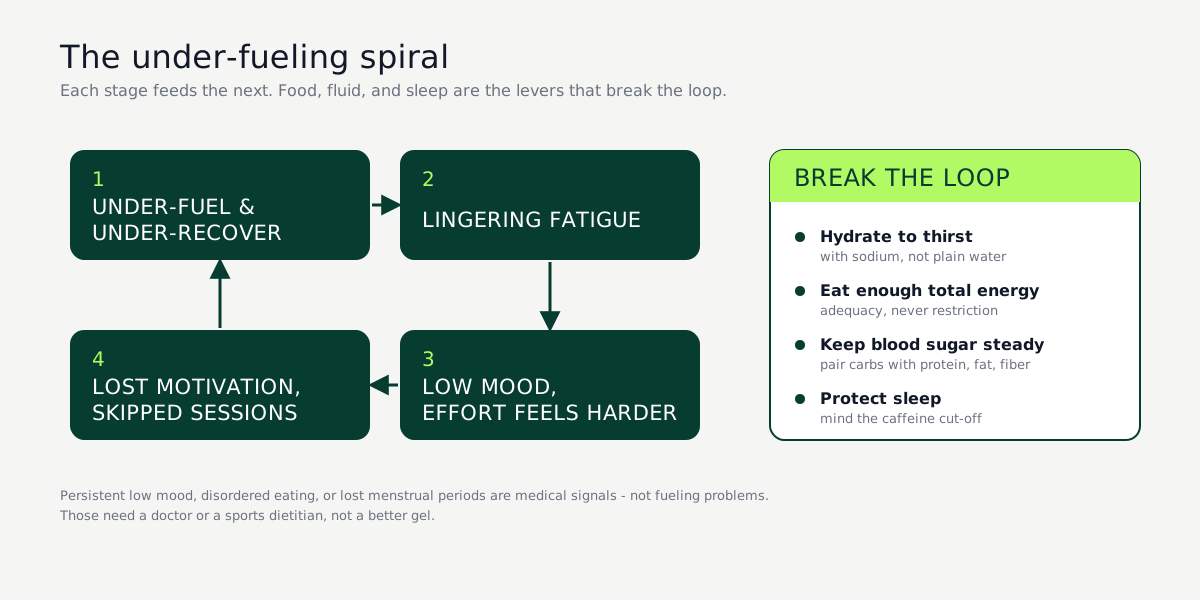
When energy intake doesn't cover training for long enough, you drop into low energy availability. The IOC's consensus on Relative Energy Deficiency in Sport, REDs (Mountjoy 2023), is explicit that the consequences are not only physical - bone, hormones, immunity - but psychological: depressed mood, irritability, poor concentration, and falling motivation. The relationship runs both ways: low energy availability can drag mood down, and a low mood can drive the restrictive eating that deepens the deficit. It is a loop, and it tightens.
That loop is the heart of the burnout spiral, and it's worth being precise about two things people blur together:
- Overtraining syndrome (OTS) is a physiological state - a long, unexplained performance drop with mood disturbance that doesn't lift with normal rest. The ECSS/ACSM consensus (Meeusen 2013) calls it a diagnosis of exclusion: before you can call it OTS, you have to rule out the boring explanations first - and inadequate energy and carbohydrate intake are explicitly on that list. A lot of "overtraining" is actually under-eating.
- Burnout is a psychological syndrome - emotional and physical exhaustion plus, uniquely, sport devaluation: the sport you loved starts to feel pointless. That cynicism is the tell that you're in burnout territory, and it's the part no recovery shake fixes.
So the fueling message on burnout is two-sided and you need both halves. Eating enough is genuinely protective: in a randomized intensified-training study (Achten 2004), runners on higher carbohydrate held onto their performance and their mood far better than those on lower carbohydrate through the same brutal block. But if the sport itself has gone grey and motivation is gone in a way food and rest aren't shifting, that's a signal to back off load and get support - not to find a better gel.
The reframe that matters: for an athlete, eating enough is a mental-health lever, not just a performance one. The fix here is almost always more food and more recovery, framed as adequacy - never as one more thing to restrict. See the recovery-nutrition guide for sizing the refuel to the gap before your next session; the spiral starts when that refuel chronically doesn't happen.
Day to day: steady energy beats the sugar high
Below the level of chronic deficit, there's the ordinary daily texture of energy and mood - and one popular idea here is simply wrong.
There is no "sugar high." A meta-analysis of 31 placebo-controlled trials (Mantantzis 2019) found that carbohydrate on its own produced no mood boost at all - and within the first hour, more fatigue and lower alertness. The "rush" is a myth; the crash is the measurable part. For day-to-day steadiness, the move is to avoid the spike-and-dip: pair carbs with protein, fat, or fiber, and lean on lower-glycemic sources at meals, saving the fast stuff for during training where rapid absorption is the whole point (see carbs-per-hour).
Acute hunger has its own well-documented effect on mood - "hangry" is real, and greater hunger reliably predicts more irritability. That's not a reason to graze constantly; it's a reason not to walk into a hard session, or a hard conversation, deep in a hole.
Eat the pattern, not the pill
People want the nutrient that fixes mood. The evidence keeps pointing at the overall pattern instead, and is mostly humble about it.
- Diet quality. A Mediterranean-style, whole-food pattern is the most-supported dietary approach for mental wellbeing, but keep the strength of evidence honest. The headline SMILES trial (Jacka 2017) was small and unblinded and its effect is widely thought to be overstated; the cleaner read is a meta-analysis of randomized trials (Firth 2019) showing a modest symptom improvement. Worth doing, not a cure.
- Supplements mostly disappoint when you're not deficient. The biggest, best-designed trials are null: long-term vitamin D did not prevent depression or lift mood in people who weren't deficient to begin with (Okereke 2020). The pattern across this field is the same - correcting a real deficiency helps; topping up someone already replete generally doesn't.
- The deficiencies actually worth checking in endurance athletes are iron (especially in women and distance runners), and B12/folate. Iron is the sharp example: correcting genuine iron deficiency reliably improves fatigue (Burden 2015) - but the trial evidence does not show it treats low mood, and self-dosing iron risks overload. Screen with bloodwork, treat with guidance; don't guess.
- Ignore the serotonin folklore. "Most of your serotonin is in your gut" is true and almost always misused - gut serotonin can't cross into the brain, so eating "for gut serotonin" doesn't lift mood. The gut-brain field is real but early; treat specific probiotic-for-mood claims as unproven. Omega-3 has the best nutrient-level signal (the EPA-rich kind), but mainly as an add-on in diagnosed depression, not as prevention - the omega-3 ingredient note has the detail.
The summary line: build a good plate most days, fix confirmed deficiencies, and be deeply skeptical of any single capsule sold as a mood fix.
Make fueling the habit that protects your motivation
Here's the loop running the good way. A session you fuel and hydrate well is a session that feels better - carbohydrate during long efforts measurably blunts the late rise in perceived effort, so the work feels less punishing. Sessions that feel better get repeated. Enjoyment today is one of the better predictors of whether you're still training months from now. That's the spiral in reverse: fuel, lower perceived effort, a better experience, more consistency.
Two practical points from behavior science, stated honestly:
- Habits form by repetition in a consistent context, not by willpower - and it takes longer than the folklore says. The real-world study everyone cites (Lally 2010) found a median of about 66 days to automaticity, with a huge spread. Forget "21 days." The lesson is to keep the fueling routine small and consistent - a pre-session drink, a post-session refuel - until the cue does the work and motivation isn't required.
- Protect sleep as part of fueling. Poor sleep raises next-day perceived effort and dents mood, and it's bidirectional with nutrition. The most actionable lever is caffeine timing - it disrupts sleep even six hours before bed - so mind the cut-off in our caffeine guide.
If you want the fueling routine made concrete for your races, the NutriFinder planner turns your weight, sport, and conditions into the fluid, sodium, and carbohydrate targets to build that habit around.
When it's not a fueling problem
This is the most important section, so it's the bluntest. Food and water are levers on mood and motivation. They are not the whole machine, and some signals are telling you to stop optimizing your nutrition and go talk to someone:
- Persistent low mood, hopelessness, or loss of interest that lasts weeks or affects your daily life. That is depression's territory, not a hydration fix.
- Any sign of disordered eating - restriction, guilt around food, eating rules that are tightening. Pushing "clean eating" or calorie-cutting at this point is harmful. This needs professional support, early.
- REDs / low-energy-availability red flags: unexplained fatigue and underperformance that won't lift with rest, frequent illness or injury, loss of menstrual periods. These warrant a sports physician and a sports dietitian. REDs and overtraining are clinical diagnoses - you can't self-assess them off a checklist.
- Sport devaluation - the activity genuinely feels pointless, not just hard. That's burnout, and the answer is load management and support, not macros.
Eating enough and drinking enough makes everything else work better. It does not replace sleep, sensible training load, or medical care - and confusing the two costs people far more than a slow race.
The bottom line
The mental side of fueling is real but modest, and it mostly comes down to three unglamorous things: don't be dehydrated, don't be chronically under-fueled, and keep your blood sugar and sleep steady. Get those right and you remove a layer of fog that has nothing to do with fitness - flatter mood, harder-feeling sessions, the slow drift toward not bothering. What you won't get is a nutritional fix for clinical depression, an eating disorder, or genuine burnout. Those deserve real care, and the most useful thing nutrition can do there is get out of the way and point you toward it.
Fuel enough to want to train. Then open the planner and make the fueling automatic.
Research and references
The findings in this guide rest on the following peer-reviewed sources. The effects described are consistently small-to-modest; verify the strength of evidence, and any health decision, against the primary literature and a qualified professional, not against any single source.
- Armstrong LE, Ganio MS, Casa DJ, et al. 2012. Journal of Nutrition. Mild dehydration affects mood in healthy young women. PMID 22190027
- Ganio MS, Armstrong LE, Casa DJ, et al. 2011. British Journal of Nutrition. Mild dehydration impairs cognitive performance and mood of men. PMID 21736786
- Wittbrodt MT, Millard-Stafford M. 2018. Medicine & Science in Sports & Exercise. Dehydration impairs cognitive performance: a meta-analysis. PMID 29933347
- Hew-Butler T, Loi V, Pani A, Rosner MH. 2017. Frontiers in Medicine. Exercise-associated hyponatremia: 2017 update. PMID 28316971
- Mountjoy M, Ackerman KE, Bailey DM, et al. 2023. British Journal of Sports Medicine. 2023 International Olympic Committee's (IOC) consensus statement on Relative Energy Deficiency in Sport (REDs). PMID 37752011
- Meeusen R, Duclos M, Foster C, et al. 2013. Medicine & Science in Sports & Exercise. Prevention, diagnosis, and treatment of the overtraining syndrome: joint consensus statement of the ECSS and ACSM. PMID 23247672
- Achten J, Halson SL, Moseley L, et al. 2004. Journal of Applied Physiology. Higher dietary carbohydrate content during intensified running training results in better maintenance of performance and mood state. PMID 14660506
- Mantantzis K, Schlaghecken F, Sünram-Lea SI, Maylor EA. 2019. Neuroscience & Biobehavioral Reviews. Sugar rush or sugar crash? A meta-analysis of carbohydrate effects on mood. PMID 30951762
- Jacka FN, O'Neil A, Opie R, et al. 2017. BMC Medicine. A randomised controlled trial of dietary improvement for adults with major depression (the "SMILES" trial). PMID 28137247
- Firth J, Marx W, Dash S, et al. 2019. Psychosomatic Medicine. The effects of dietary improvement on symptoms of depression and anxiety: a meta-analysis of randomized controlled trials. PMID 30720698
- Okereke OI, Reynolds CF, Mischoulon D, et al. 2020. JAMA. Effect of long-term vitamin D3 supplementation vs placebo on risk of depression or clinically relevant depressive symptoms and on change in mood scores (VITAL-DEP). PMID 32749491
- Burden RJ, Morton K, Richards T, et al. 2015. British Journal of Sports Medicine. Is iron treatment beneficial in iron-deficient, but non-anaemic, endurance athletes? A systematic review and meta-analysis. PMID 25361786
- Lally P, van Jaarsveld CHM, Potts HWW, Wardle J. 2010. European Journal of Social Psychology. How are habits formed: modelling habit formation in the real world. doi:10.1002/ejsp.674